
Course Content
IN THIS LESSON
1. The Christian claim: Jesus saves
What “Savior” means
To call Jesus Christ Savior means that He rescues humanity from sin, death, corruption, demonic bondage, alienation from God, and the disfigurement of human nature.
The title does not mean that Christ merely offers good moral instruction, emotional consolation, or an inspiring example.
Humanity’s deepest problem is not lack of information, political disorder, economic difficulty, or personal unhappiness—though all are real human problems. The deepest wound is estrangement from God, the Source of life.
Christ saves not by changing God from hostile to loving, but because the loving God acts in His Son to heal and restore fallen humanity.
“Of the world”
Christ is the Savior of the world: His saving work is universal in scope and intended for all peoples, nations, languages, social classes, and stages of life.
This does not mean that salvation is automatic or that human freedom is irrelevant. God calls every person to faith, repentance, baptism, perseverance, and communion with Christ.
“World” includes the whole created order as well as humanity. The final Christian hope is not escape from material creation, but its renewal and transfiguration.
The Church does not proclaim a tribal or merely private salvation. The Gospel is good news for the whole human race.
Why humanity needs salvation
Human beings are created good and called to communion with God, but sin introduces alienation, mortality, disordered desire, and slavery to passions.
Death is not merely a natural fact to be accepted neutrally; in Christian proclamation it is an enemy of human beings, tied to humanity’s fallen condition.
The human person cannot heal himself solely through education, ethical effort, technology, ritual, or philosophical insight.
A Savior must be both fully divine—able to impart divine life—and fully human—able to heal human nature from within.
2. The saving purpose of the Incarnation
God becomes man for humanity’s healing
The eternal Son of God takes true human nature from the Virgin Mary and becomes Jesus Christ.
He enters human history not as an observer but as the One who assumes the reality of human life: body, soul, mind, will, suffering, mortality, relationships, labor, hunger, weariness, grief, and temptation—yet without sin.
His incarnation is already saving because the uncreated God joins Himself personally to created human nature.
The Son does not stop being God when He becomes man; He is one Person, fully God and fully man.
“What is not assumed is not healed”
Orthodox theology emphasizes that Christ assumes the fullness of human nature in order to heal the fullness of human nature.
If Christ were not genuinely human, human nature would remain unhealed.
If Christ were not genuinely God, His work could not unite humanity to the uncreated life of God.
Salvation therefore depends upon the truth confessed at the Council of Chalcedon: Jesus Christ is one divine Person in two complete natures, divine and human, without confusion or separation.
Christ’s sinlessness
Christ shares human nature but not personal sin.
He undergoes genuine temptation but never consents to evil.
His sinlessness is not distant from human struggle; it reveals authentic human freedom, perfect obedience, and complete love of the Father.
In Christ, humanity is shown as it was meant to be: faithful, holy, free, obedient, loving, and alive to God.
3. Christ’s life as saving work
The Gospel is salvation in action
Christ saves through the totality of His incarnate life, not only through one isolated moment.
His birth sanctifies human birth and childhood.
His baptism reveals the Trinity and inaugurates His public ministry; it also sanctifies the waters and anticipates the believer’s baptismal union with Him.
His temptation in the wilderness overturns humanity’s repeated surrender to the devil’s lies.
His preaching announces God’s kingdom and calls people to repentance, faith, forgiveness, mercy, and holiness.
His healings reveal that salvation is restoration: sight, cleansing, wholeness, reconciliation, deliverance, and life.
His table fellowship with sinners displays divine mercy, while His call to “sin no more” shows that mercy summons people into a changed life.
Miracles and authority
Christ heals diseases, forgives sins, casts out demons, commands the elements, raises the dead, and receives worship.
These acts are signs of His divine authority and foretastes of the coming kingdom.
Miracles are not displays meant to impress crowds. They reveal the compassionate reign of God and the restoration of a world damaged by sin and death.
Christ’s authority over demons shows that evil spiritual powers do not have ultimate control over humanity.
Christ as Teacher and Physician
Jesus teaches the truth about God, humanity, sin, prayer, judgment, mercy, marriage, wealth, power, and the kingdom.
His teaching is not separated from His person. The One who speaks is the incarnate Word of God.
He is the physician of souls and bodies: He identifies the human disease, offers forgiveness and healing, and gives the Church the medicine of grace.
His commandments are not arbitrary burdens. They reveal the path to true human life and communion with God.
4. The Cross: Christ’s voluntary sacrifice
The Passion is voluntary
Christ’s arrest, suffering, and crucifixion are not accidental defeats or proof that evil overpowered God.
He freely goes to the Cross in obedience to the Father and in love for humanity.
His humility reverses the pride and self-will of fallen humanity.
On the Cross, Christ bears the full weight of human sin, suffering, violence, betrayal, shame, and death without responding with hatred, despair, or disobedience.
Sacrifice and reconciliation
Christ is the true High Priest who offers Himself.
He is also the sacrificial Lamb, fulfilling and transforming the Old Testament pattern of sacrifice.
His sacrifice is perfect because it is the self-offering of the sinless God-man, made once for all and continually participated in through the Church’s Eucharistic life.
The Cross reconciles humanity to God, destroys hostility, exposes the false claims of sin and death, and opens the way of forgiveness.
Avoiding a distorted picture
Orthodox teaching does not portray the Father as personally hostile to the Son or as needing to be persuaded to become merciful.
The Father sends the Son in love; the Son willingly gives Himself in love; the Holy Spirit accomplishes and applies this saving work in the lives of believers.
Salvation is the united action of the Holy Trinity.
The Cross should not be reduced to a merely legal transaction, a moral example only, or a political martyrdom only. It is God’s saving victory enacted within real history.
5. Christ’s descent, Resurrection, and victory
Death defeated from within
Christ truly dies in His humanity. His soul is separated from His body, though neither is separated from His divinity.
By entering death voluntarily, Christ penetrates and destroys death’s power from within.
The descent into Hades proclaims His victory to the dead and announces that the realm of death cannot imprison the Lord of life.
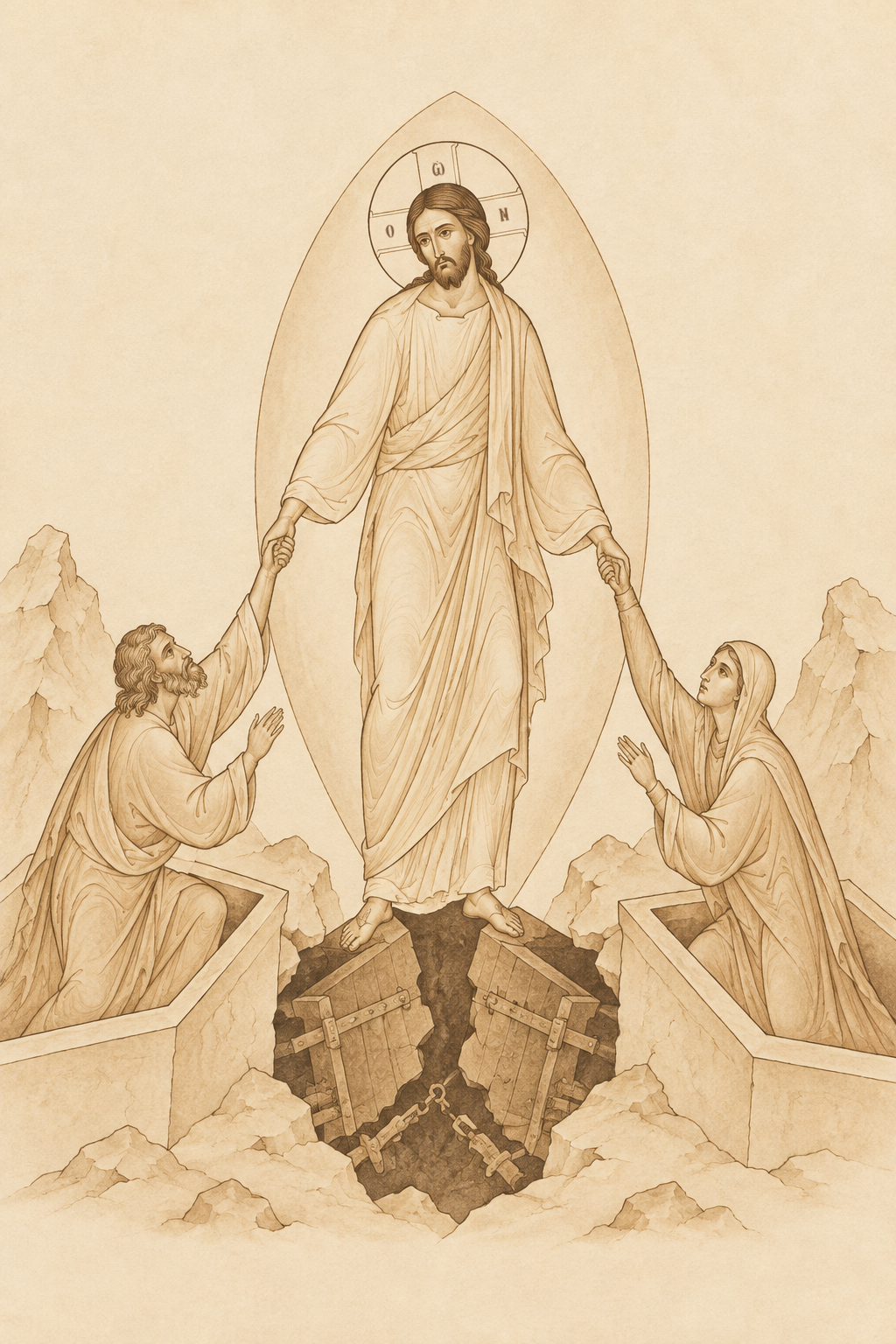
In Orthodox iconography and worship, the Resurrection is often shown as Christ breaking the gates of Hades and raising Adam and Eve, expressing salvation’s reach to the whole human race.
The bodily Resurrection
Christ rises bodily on the third day.
His resurrection is not merely the continuation of His memory, a symbol of hope, or a spiritual experience of the disciples. It is a real victory over death.
The risen Christ’s body is the same body that suffered, yet glorified, incorruptible, and no longer subject to death.
His Resurrection inaugurates the new creation and becomes the foundation for Christian hope in the resurrection of the dead.
Ascension and enthronement
The risen Christ ascends bodily into heaven and is seated at the right hand of the Father.
Humanity, united to the Son, is brought into glory and access to the Father.
Christ remains the God-man; the incarnation is not temporary.
His ascension is not abandonment. As the glorified Lord, He reigns, intercedes, sends the Holy Spirit, and remains present to His Church.
6. How Christ’s salvation reaches us
Union with Christ
Salvation is not simply agreement with Christian ideas; it is participation in Christ’s life.
Through baptism, believers are united to Christ’s death and Resurrection, receive forgiveness, and begin a new life.
Through chrismation, the Holy Spirit seals and empowers believers.
Through the Eucharist, the faithful receive communion in Christ’s Body and Blood, becoming more deeply united to Him and to one another.
Through confession, the person repeatedly receives forgiveness, healing, and restoration after baptismal sin.
Synergy: grace and human freedom
God’s grace initiates, sustains, and completes salvation. Human beings do not save themselves by earning God’s favor.
Yet grace does not cancel freedom. People are called to respond, repent, believe, obey, pray, forgive, persevere, and cooperate with grace.
This cooperation is called synergy. It rejects both self-salvation through personal achievement and passive fatalism.
A simple illustration: a physician may provide diagnosis, medicine, and treatment, but the patient must receive the medicine and follow the treatment rather than refuse it.
Salvation as theosis
The ultimate aim is not merely avoidance of punishment after death.
Salvation is healing, reconciliation, adoption, sanctification, resurrection, and theosis—participation in God’s uncreated life by grace.
Theosis does not make a person God by nature or merge a person into the divine essence. It perfects the person’s human nature in communion with God.
Theosis is sharing in Christ’s divine life by God’s uncreated grace, received through Christ, the Church’s sacraments, and the indwelling Holy Spirit.
7. The Church and the Savior
The Church as Christ’s Body
Christ’s saving work is received in the Church, His Body.
The Church is not merely a voluntary association of people sharing religious opinions. It is the sacramental communion in which Christ’s life is communicated by the Holy Spirit.
In the Church, believers hear the Gospel, are baptized, receive the Eucharist, repent in confession, learn to pray, serve neighbors, and grow toward holiness.
This does not mean that God’s mercy is confined by human institutional limits. It means that Christ has actually established a concrete, communal, sacramental means of salvation.
The saints as evidence of salvation
The saints demonstrate what Christ’s saving grace can do in human lives.
They are not alternate saviors or independent sources of salvation; they are people transformed by union with Christ.
Their humility, repentance, courage, purity, mercy, prayer, and love reveal the fruit of salvation.
Veneration of saints honors the grace of Christ manifested in them and encourages believers to follow the same path of repentance and faithfulness.
8. Salvation and the life of faith
Faith is living trust
Faith involves accepting the truth that Christ reveals, but it is more than intellectual agreement.
It is personal trust in Christ, loyalty to Him, worship of Him, and a willingness to order one’s life under His lordship.
Saving faith bears fruit in repentance and obedience; a faith that refuses transformation is not the fullness of Christian faith.
Repentance and daily conversion
Repentance is ongoing because believers continue to struggle with sin, passions, wounds, and temptations.
The Christian does not repent in order to earn Christ’s love; one repents because Christ has opened the path back to life.
Regular prayer, fasting, almsgiving, forgiveness, Scripture reading, Liturgy, and confession shape the person into Christ’s likeness.
A fall into sin should prompt a quick return to God, not prolonged hiding, rationalization, or despair.
Love of neighbor
Christ’s salvation changes relationships as well as private religious feeling.
The believer is called to forgive enemies, care for the poor, protect the vulnerable, speak truthfully, resist injustice, practice sexual purity, and show mercy.
Love of neighbor is not an optional charitable add-on. It is a visible fruit of union with Christ.
Christian love joins truth and mercy; it refuses both cruelty and indifference to sin.
9. The completion of salvation
Christ will come again
The Savior who came in humility will return in glory to judge the living and the dead.
His judgment is not contrary to His mercy. It reveals the truth of every life, exposes evil, vindicates goodness, and brings God’s purposes to fulfillment.
Christians live in hope and watchfulness, preparing for Christ’s return through faithfulness rather than speculative date-setting.
Resurrection and new creation
The final hope includes the resurrection of all the dead.
God will renew creation; evil, corruption, suffering, and death will not have the final word.
Eternal life is communion with God, participation in His glory, and the fulfillment of human beings’ created purpose.
Hell should not be treated casually as a speculative punishment for others. The reality of judgment calls each person to humility, repentance, intercession, and serious love.
10. Scripture for study
Isaiah 9:2–7; 11:1–10; 53:1–12 — The promised Messiah, kingdom, and suffering servant
Matthew 1:18–25; 4:1–17; 9:1–8; 11:28–30; 25:31–46 — Christ’s birth, temptation, authority to forgive, invitation, and judgment
Luke 1:26–38; 4:16–21; 7:18–23; 15; 19:1–10; 23:33–49 — Incarnation, mission, mercy, repentance, salvation, and Crucifixion
John 1:1–18; 3:16–17; 4:39–42; 10:10–18; 11:25–26; 12:23–33; 20 — The Word made flesh, Savior of the world, life, voluntary sacrifice, and Resurrection
Acts 2:22–36; 4:10–12 — Christ’s death, Resurrection, exaltation, and saving name
Romans 5:6–21; 6:3–11; 8:18–25 — Christ’s saving death, baptismal union, and creation’s hope
1 Corinthians 15:1–28, 45–58 — Resurrection and Christ’s triumph over death
2 Corinthians 5:14–21 — Reconciliation and new creation
Ephesians 1:3–14; 2:1–10 — Grace, adoption, and new life
Philippians 2:5–11 — Christ’s humility, obedience, and universal lordship
Colossians 1:13–20; 2:9–15 — Deliverance, reconciliation, and victory over hostile powers
Hebrews 2:9–18; 4:14–16; 9:11–28 — Christ’s shared humanity, priesthood, and self-offering
1 Peter 2:21–25; 3:18–22 — Christ’s suffering, healing, descent, and baptism
1 John 4:9–14 — The Father sends the Son as Savior of the world
Revelation 21–22 — New creation and final communion with God
Questions for reflection
From what, specifically, does Jesus Christ save human beings according to Orthodox Christianity?
Why does the title “Savior of the world” rule out both ethnic exclusivism and the idea that salvation is merely private?
Why must Christ be fully God and fully human in order to save?
How does the Cross reveal the united love of the Father, Son, and Holy Spirit rather than conflict within the Trinity?
In what ways is salvation more than escaping punishment after death?
How do baptism, chrismation, Eucharist, confession, prayer, and fasting connect a person to Christ’s saving work?
What does synergy protect against: self-reliance on one hand and spiritual passivity on the other?
Which concrete area of daily life needs to be brought more honestly under Christ’s healing and lordship?
How does Christ’s bodily Resurrection change a Christian understanding of illness, aging, mourning, the body, and death?
What would it mean this week to live not merely as someone who admires Jesus, but as someone united to and being healed by Him?