
Course Content
IN THIS LESSON
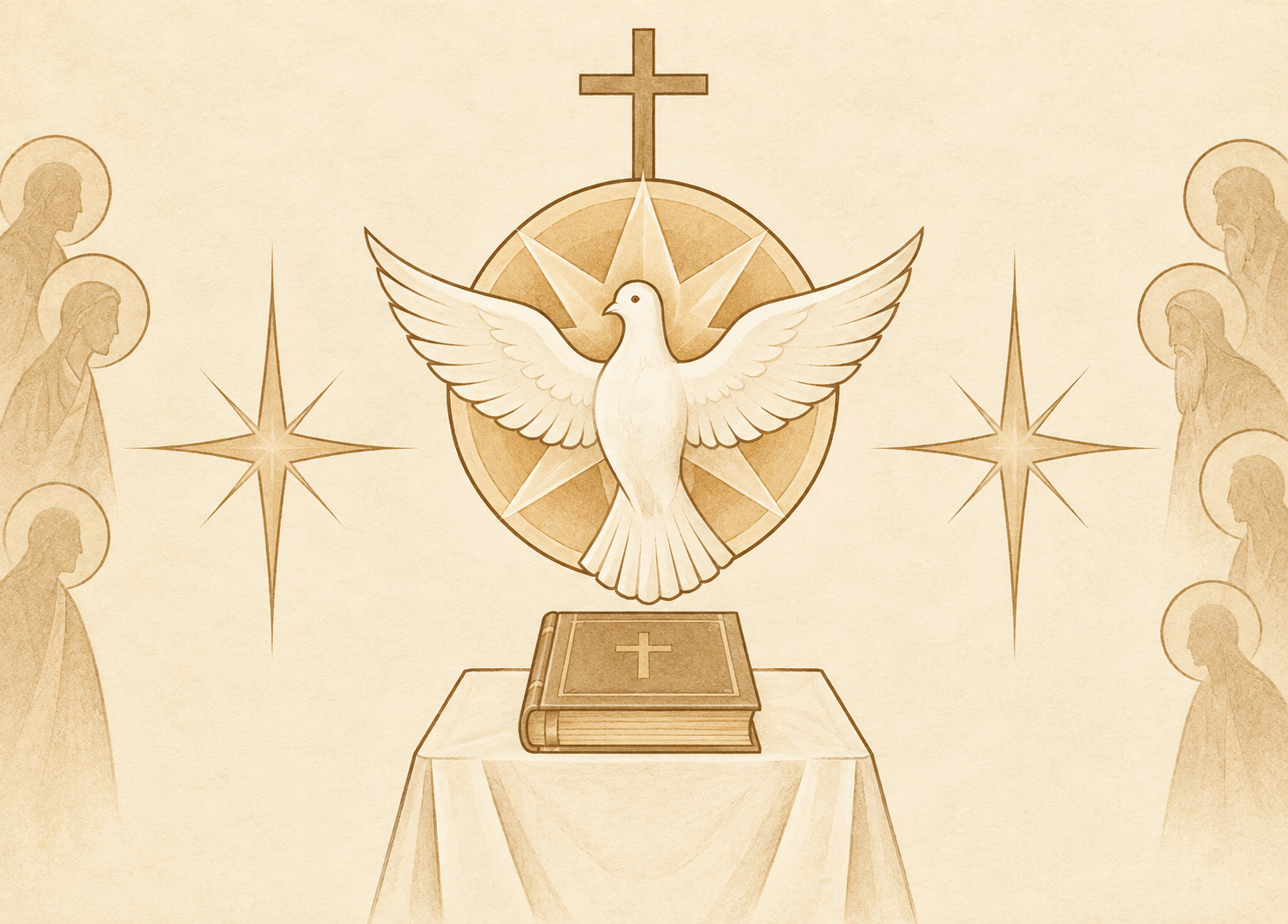
1. The Holy Spirit: Lord and Giver of Life
The Spirit is fully God
The Holy Spirit is one of the three Persons of the Holy Trinity: fully divine, eternal, uncreated, and worthy of the same worship and glorification as the Father and the Son.
The Spirit is not an impersonal power, an emotion, a vague “spiritual energy,” an influence, or simply the name for God’s activity in the world.
The Spirit speaks, teaches, leads, comforts, intercedes, can be grieved, and distributes gifts freely. These are personal actions, not merely impersonal effects.
The Nicene-Constantinopolitan Creed calls Him: “the Lord, the Giver of Life, who proceeds from the Father, who with the Father and the Son together is worshiped and glorified, who spoke by the prophets.”
One God in three Persons
The Father, Son, and Holy Spirit are not three gods, nor three temporary roles played by one divine individual.
They share one undivided divine essence; each is wholly God.
The Persons are distinguished by their eternal relations:
The Father is unbegotten and the eternal source within the Trinity.
The Son is eternally begotten of the Father.
The Holy Spirit eternally proceeds from the Father.
All divine actions toward creation are inseparable: the Father acts through the Son in the Holy Spirit.
The Spirit’s mission
The Spirit reveals Christ, makes Christ present in the Church, unites believers to Christ, and leads them into communion with the Father.
The Spirit does not draw attention away from the Son or introduce a competing religion of private inspiration.
A reliable spiritual principle is that the Spirit glorifies Jesus Christ and forms believers in Christlike holiness, humility, truth, repentance, and love.
2. The Holy Spirit in creation and revelation
The Spirit and creation
The Holy Spirit is active in the creation and ongoing preservation of the world.
The Spirit is called the “Giver of Life” because all life depends upon God’s life-giving presence.
Scripture presents the Spirit as hovering over the waters at creation and as renewing the face of the earth.
The Spirit gives breath, order, beauty, fruitfulness, wisdom, and life, though creation remains distinct from God and is not itself divine.
The Spirit in the Old Testament
The Spirit speaks through the prophets, prepares Israel for Christ, and equips particular persons for service.
The Spirit gives wisdom to leaders, strength to judges, skill to artisans, courage to prophets, and inspiration for psalmody and worship.
The prophets anticipate an outpouring of the Spirit upon God’s people, associated with forgiveness, a renewed heart, obedience, and the age of the Messiah.
The Holy Spirit’s activity in Israel is continuous with His activity in the Church; Pentecost fulfills rather than abolishes the Old Testament’s hope.
The Spirit and the Incarnation
The Holy Spirit overshadows the Virgin Mary at the Annunciation, bringing about the conception of the incarnate Son.
The Spirit rests upon Christ at His baptism in the Jordan, revealing the Holy Trinity: the Father’s voice, the Son in the waters, and the Spirit descending in visible form.
Christ is conceived by the Spirit, anointed by the Spirit, led by the Spirit, and offers Himself in the Spirit.
The Spirit’s work is inseparable from Christ’s saving mission; He prepares, manifests, and applies the salvation accomplished by the Son.
3. The Spirit and the saving work of Christ
Christ promises the Spirit
Before His Passion, Christ promises to send the Holy Spirit—the Comforter, Advocate, Helper, or Paraclete—to His disciples.
The Spirit would remain with the Church, teach believers, remind them of Christ’s words, guide them into truth, and strengthen their witness.
The Spirit does not reveal a Gospel different from Christ’s Gospel; He enables the Church to understand, proclaim, and embody the Gospel faithfully.
The Spirit makes Christ’s saving work present and effective across time and place.
Pentecost
Pentecost is the public manifestation of the Spirit’s outpouring upon the Church.
The descent of the Spirit empowers the apostles to proclaim Christ boldly and intelligibly to people of many languages.
Pentecost reverses the alienation symbolized at Babel: without erasing distinct peoples and languages, the Spirit creates unity in the confession of Christ.
The Church’s mission is impossible by human ability alone. The Spirit gives courage, wisdom, discernment, endurance, gifts, and love for witness.
The Spirit and the Resurrection
The life-giving Holy Spirit, along with the Father, participates in Christ’s Resurrection and gives believers hope for bodily resurrection.
The same Spirit who gives new life in baptism and sanctification will complete God’s work in the resurrection of the dead.
The Spirit is therefore not only a source of present spiritual experience, but the pledge of the coming kingdom and the renewal of creation.
4. Procession and the Filioque
The Orthodox confession
Orthodox Christians confess, with the Creed of Constantinople, that the Holy Spirit proceeds from the Father.
This expresses the Father’s unique role as the eternal source within the Holy Trinity.
The Son is eternally begotten from the Father; the Spirit eternally proceeds from the Father.
These distinct eternal relations preserve the real personal distinctions within the Trinity without dividing the divine nature.
“Through the Son” and the Spirit’s mission
Orthodox theology can speak of the Spirit being revealed, given, sent, and manifested through the Son in the economy of salvation.
The Father sends the Spirit through the Son into the world; the Son breathes the Spirit upon the disciples after the Resurrection.
This temporal mission does not mean that the Spirit’s eternal origin is from the Son as a second source.
The distinction matters because it safeguards both the Father’s unique personhood as source and the Spirit’s own distinct hypostasis.
The Filioque controversy
The Filioque is the Latin phrase “and the Son,” added in the West to the Creed’s wording about the Spirit’s procession.
Orthodoxy objects both to the unilateral alteration of the ecumenically received Creed and to formulations that make the Son a co-source of the Spirit’s eternal procession.
The issue is not merely vocabulary. It concerns the Church’s confession of the Trinity, the authority to alter the Creed, and the meaning of the Father’s unique monarchy.
In ecumenical discussion, terms and theological intent require care; Christians should avoid caricature and polemical oversimplification while remaining clear about the Orthodox Creed.
5. The Spirit and the Church
The Church as Pentecostal communion
The Church is the Body of Christ, animated and sustained by the Holy Spirit.
The Spirit gathers diverse persons into one Eucharistic and apostolic communion rather than merely affirming isolated private spirituality.
The Church’s unity is not uniformity. The Spirit gives different gifts, languages, cultures, ministries, and vocations while creating one faith and one life in Christ.
The Spirit preserves the Church in the apostolic faith, though individual Christians and church leaders may sin, err, or fail morally.
The Spirit and Holy Tradition
Holy Tradition is not merely human custom or institutional memory. It is the apostolic faith, worship, Scripture, doctrine, and spiritual life received and transmitted in the Holy Spirit.
The Spirit inspired the Scriptures, guides the Church’s reception and interpretation of Scripture, and protects the Church’s essential confession of Christ.
This does not make every historical practice, local custom, or opinion automatically infallible. Discernment remains necessary.
The Church tests claims of revelation by their conformity to Scripture, apostolic faith, worship, the Ecumenical Councils, and the life of the saints.
The Spirit and the sacraments
The Holy Spirit makes sacramental life life-giving rather than merely symbolic.
In baptism, the Spirit grants new birth and incorporates the person into Christ.
In chrismation, the believer is sealed with the gift of the Holy Spirit.
In the Eucharistic liturgy, the Church invokes the Spirit to sanctify the gifts and the faithful.
In confession, the Spirit restores the repentant person to communion and strengthens the struggle against sin.
In ordination, marriage, unction, and all liturgical blessing, the Church asks God’s Spirit to sanctify and equip persons for their vocation.
6. The Spirit in the individual believer
Receiving the Holy Spirit
The Spirit is received as a gift, not earned as a reward for religious achievement.
The ordinary sacramental entry into this life is baptism and chrismation, followed by ongoing participation in the Eucharist and life of the Church.
Every baptized believer is called to grow in conscious dependence on the Spirit, but the Spirit is not possessed or controlled by any person.
A person cannot treat spiritual gifts, prayer practices, or religious experiences as proof of superiority over others.
Indwelling and transformation
The Spirit dwells in believers, making them temples of God.
He illuminates the mind, convicts of sin, strengthens the will, heals the passions, teaches prayer, and produces virtues.
The goal is transformation into Christ’s likeness: humility, purity, mercy, courage, faithfulness, patience, gentleness, self-control, and love.
Spiritual maturity is shown primarily by repentance and the fruit of the Spirit, not by dramatic experiences, claims of visions, or public displays of giftedness.
Prayer in the Spirit
Orthodox prayer usually begins with invocation of the Holy Spirit: “O Heavenly King, the Comforter, the Spirit of Truth…”
The Spirit enables believers to address God as Father and to confess Jesus as Lord.
He intercedes when human beings are weak and do not know how to pray as they ought.
Prayer in the Spirit is not necessarily emotional intensity; it is prayer shaped by faith, humility, attention, repentance, perseverance, and obedience.
7. Gifts, fruit, and discernment
Spiritual gifts
The Holy Spirit freely distributes gifts for the building up of the Church.
Such gifts may include wisdom, teaching, discernment, service, generosity, hospitality, leadership, healing, prophecy, tongues, interpretation, and courage in witness.
Gifts are given for service, not spiritual status, entertainment, control, or self-promotion.
No particular extraordinary gift should be made a universal test of whether someone has received the Holy Spirit.
The fruit of the Spirit
The most reliable evidence of the Spirit’s work is the fruit of a transformed life: love, joy, peace, patience, kindness, goodness, faithfulness, gentleness, and self-control.
Humility, chastity, mercy, forgiveness, truthfulness, and sacrificial service also display the Spirit’s sanctifying work.
A person may possess talent, knowledge, charisma, or outward religious activity while lacking the humility and love that show genuine spiritual maturity.
The gifts of the Spirit should increase communion and love, not division, pride, obsession with status, or contempt for others.
Testing spiritual experiences
Christians should neither mock nor eagerly chase extraordinary spiritual phenomena.
Experiences, visions, dreams, prophecies, emotional states, or inner voices require discernment.
A claimed spiritual experience should be tested by whether it is consistent with Scripture, the Church’s faith, Christlike humility, peace, obedience, and the counsel of spiritually mature persons.
In Orthodox spiritual practice, it is safer to reject prideful self-certainty than to assume every striking experience is from God.
The Holy Spirit never contradicts the Gospel, excuses sin, produces arrogance, or separates a person from the Church’s life.
8. Sin against the Holy Spirit
Resisting grace
Human beings can resist, grieve, and quench the Holy Spirit through persistent sin, hardness of heart, contempt for truth, hatred, refusal of repentance, and rejection of divine mercy.
The Spirit convicts people of sin in order to heal them, not merely to condemn them.
A tender conscience should be protected through regular prayer, repentance, confession, forgiveness, and responsiveness to correction.
The “unforgivable sin”
Christ warns about blasphemy against the Holy Spirit.
Orthodox pastoral interpretation commonly understands this not as a single accidental statement beyond God’s willingness to forgive, but as a settled and hardened refusal of the Spirit’s witness to Christ and rejection of repentance itself.
No person who genuinely seeks repentance should conclude that he or she is beyond hope; concern for reconciliation with God is itself evidence that the heart has not finally closed itself to grace.
The remedy for fear and despair is humble confession, trust in Christ’s mercy, and perseverance in the Church’s life.
9. Practical catechetical application
Living by the Spirit
Begin daily prayer by asking for the Holy Spirit’s cleansing, presence, guidance, and illumination.
Participate faithfully in Divine Liturgy and receive the sacraments with preparation and repentance.
Read Scripture not merely for information but as a call to obedience and transformation.
Practice watchfulness over thoughts, words, and reactions; ask the Spirit to expose pride, resentment, lust, greed, despair, and self-deception.
Seek reconciliation quickly where possible, because bitterness and unforgiveness obstruct spiritual growth.
Use personal gifts and resources for the good of others rather than for recognition.
A simple weekly practice
Pray the Orthodox invocation to the Holy Spirit slowly at the beginning of morning or evening prayer.
Read one passage about the Spirit, such as John 14–16, Acts 2, Romans 8, or Galatians 5.
Identify one recurring passion—anger, vanity, greed, discouragement, or self-will—and name it honestly before God.
Choose one corresponding action of cooperation with grace: apology, fasting, generosity, reconciliation, silence, service, or confession.
At day’s end, give thanks for specific gifts of God and ask forgiveness for resistance to the Spirit.
10. Scripture for study
Genesis 1:1–2 — The Spirit in creation
Psalm 51:10–12; Psalm 104:24–30 — Renewal, God’s Spirit, and life
Isaiah 11:1–5; 32:15–18; 44:3–5; 61:1–3 — The Spirit’s gifts and promised outpouring
Ezekiel 36:24–28; 37:1–14 — A new heart, new spirit, and life from dry bones
Joel 2:28–32 — The promised outpouring of the Spirit
Matthew 3:13–17; 12:22–32; 28:18–20 — Theophany, warning concerning the Spirit, and Trinitarian baptism
Luke 1:26–38; 4:16–21; 11:9–13 — Annunciation, Christ’s anointing, and asking for the Spirit
John 3:1–8; 7:37–39; 14:15–27; 15:26; 16:5–15; 20:19–23 — New birth, living water, the Paraclete, and the risen Christ’s gift
Acts 1:4–8; 2:1–47; 8:14–17; 10:44–48; 15:6–11 — Pentecost, mission, chrismation-like reception, and the Church’s discernment
Romans 8:1–17, 26–27 — Life, adoption, and prayer in the Spirit
1 Corinthians 12–14 — Gifts, love, and order in the Church
2 Corinthians 3:17–18 — Freedom and transformation by the Spirit
Galatians 5:16–26 — Life in the Spirit and spiritual fruit
Ephesians 1:13–14; 4:30; 5:18–21 — Sealing, grieving the Spirit, and Spirit-filled worship
1 John 4:1–6 — Testing the spirits
Revelation 22:17 — The Spirit and the Bride’s invitation
Questions for reflection
Why is it essential to confess the Holy Spirit as a divine Person, not an impersonal force?
What does it mean to say that the Spirit proceeds from the Father while being sent into the world through the Son?
How do Pentecost and the Church’s sacramental life connect the Spirit’s work to Christ rather than to private spirituality?
What distinguishes a spiritual gift from the fruit of the Spirit?
Why can an impressive religious experience not, by itself, prove spiritual maturity or divine origin?
How does Orthodox discernment protect a person from both skepticism and spiritual credulity?
What does it mean to “grieve” or resist the Holy Spirit in ordinary life?
Which fruit of the Spirit most needs cultivation in your present circumstances, and what concrete practice could cooperate with that grace?