
Course Content
IN THIS LESSON
1. The confession of Jesus Christ
The decisive Christian question
The Christian faith stands or falls on the identity of Jesus Christ.
Jesus is not merely a remarkable teacher, moral reformer, prophet, miracle-worker, or spiritual example.
The Church confesses that Jesus Christ is the eternal Son and Word of God, truly God before all ages, who truly became man for the salvation of the world.
To confess Christ rightly is to confess both:
His full and eternal divinity
His full and real humanity
The name Jesus means “the Lord saves”; the title Christ means “the Anointed One,” the Messiah promised in the Scriptures.
“Son of God” does not mean that Christ is a creature produced by God, nor does it describe a merely adopted relationship. It confesses His eternal relationship to the Father and His full divinity.
Peter’s confession
When Peter says, “You are the Christ, the Son of the living God,” he gives the central apostolic confession of the Church.
Christ says that this knowledge is not merely human deduction but revelation from the Father.
Every Christian is called not only to repeat this confession verbally but to live in a way that recognizes Christ as Lord.
2. The eternal Son and Word
Begotten, not made
The Son exists eternally with the Father.
He is begotten, not created: His divine origin is eternal and wholly unlike the creation of the world.
The Son is “of one essence” with the Father, as confessed in the Nicene Creed. Whatever it means to be God by nature belongs fully to the Father and fully to the Son.
There was never a time when the Son did not exist. The Father is eternally Father, and the Son is eternally Son.
The Word of God
The Son is called the Logos, or Word, of God.
As the Word, He perfectly reveals the Father. To see and know the Son is to be brought into the knowledge of the Father.
The Word is not an impersonal message, idea, or divine force. He is a divine Person.
Through the Word, all things are created; through the same Word, fallen creation is restored.
The Son’s relation to creation
Christ is distinct from creation. He is not the highest creature, an angel, a semi-divine intermediary, or a divine being who came into existence before the world.
All created things come into being through Him and are sustained by Him.
His incarnation does not mean that God is absorbed into the world. It means that the uncreated Son freely enters His creation without ceasing to be what He eternally is.
3. The incarnation
“The Word became flesh”
In the incarnation, the eternal Son of God assumes a complete human nature from the Virgin Mary.
He does not merely appear human, inhabit a human body, or temporarily use a human person as an instrument.
Jesus Christ is one divine Person—the Son—who possesses both complete divine nature and complete human nature.
He is fully God and fully man, without mixture, confusion, division, or separation.
Why the incarnation matters
Humanity could not save itself from sin, death, and corruption.
God the Son becomes man in order to heal humanity from within.
Christ assumes what belongs to human life—body, soul, mind, will, vulnerability to suffering, and mortality—while remaining without sin.
Orthodox theology commonly expresses this saving principle as: what is not assumed is not healed.
Because Christ truly becomes human, He redeems the whole human person, not just a spiritual fragment detached from bodily life.
The Virgin Mary and the Theotokos
Jesus is conceived by the Holy Spirit and born of the Virgin Mary.
The Church calls Mary Theotokos, “God-bearer” or “Mother of God,” because the one born from her is truly God the Son incarnate.
This title protects the truth about Christ. It does not mean that Mary created the divine nature or existed before God; it means that the child she bore is one Person, Jesus Christ, who is fully God and fully man.
Christ receives real humanity from Mary. His human life is not an illusion, and His body is not brought from heaven as though unrelated to human nature.
4. One Person, two natures
The Chalcedonian confession
The Church confesses that Jesus Christ is:
One and the same Son, Lord, and Christ
Perfect in divinity and perfect in humanity
Truly God and truly man
Of one essence with the Father according to divinity
Of one essence with humanity according to His human nature
One Person in two natures, united without confusion, change, division, or separation
This language safeguards the Gospel’s full claim: the One who is born, hungers, suffers, dies, rises, and ascends is the eternal Son of God incarnate.
What the union does not mean
It does not mean that Christ’s divinity and humanity blend into a third mixed nature.
It does not mean that Christ is two separate persons—one divine and one human—acting alongside each other.
It does not mean that His humanity is incomplete, passive, or replaced by His divinity.
It does not mean that His divine nature suffers change, death, or limitation in itself.
Rather, the divine Son personally experiences authentic human life in the human nature He has freely assumed.
Christ’s human will
Christ has a real human will as well as the divine will He eternally shares with the Father and Holy Spirit.
His human will is not sinful or opposed to God; it freely and perfectly cooperates with the divine will.
In Gethsemane, Christ’s human dread of death is real, yet He freely offers obedience to the Father: “Not My will, but Yours, be done.”
This heals the human will, which in fallen humanity is often divided, weak, and enslaved by passion.
5. Christ’s saving work
Christ reveals the Father
Jesus does not merely communicate information about God. As the incarnate Son, He reveals the Father in His own person, words, works, compassion, authority, and self-offering.
His teaching, miracles, forgiveness of sins, command over demons, healing of the sick, and authority over death show that God’s kingdom has drawn near.
Christ makes visible God’s mercy, holiness, justice, truth, and love.
Christ conquers sin and death
Jesus lives in perfect obedience where humanity repeatedly fails.
He confronts the devil’s temptations and refuses the false paths of self-will, spectacle, worldly power, and distrust of the Father.
In His voluntary Passion and death, Christ enters the deepest consequence of the Fall—death itself.
By His resurrection, He defeats death from within and opens the way to renewed human life.
Salvation is not merely external pardon; it is liberation from the tyranny of sin and death, restoration to communion with God, and transformation by divine grace.
Christ as Prophet, Priest, and King
Prophet: Christ reveals the Father’s truth and calls humanity to repentance, faith, and life in the kingdom of God.
Priest: He offers Himself to the Father and brings humanity into reconciliation and communion with God.
King: He reigns through truth, humility, sacrificial love, and victory over sin, death, and demonic power.
His kingdom is not established through coercive political force. It is manifested in the Church, in holiness, in mercy, and ultimately in His glorious return.
Christ as the new Adam
Adam represents fallen humanity: distrust, disobedience, exile, corruption, and death.
Christ is the new Adam: obedience, faithfulness, restoration, life, and the beginning of a renewed humanity.
Where Adam grasped at self-rule, Christ humbles Himself in obedient love.
Through union with Christ, believers receive a new identity and a new possibility of life.
6. Major errors the Church rejects
Denial of Christ’s divinity
Arianism treats the Son as created or less than God.
This destroys the Christian claim that God Himself has come to save humanity. A creature cannot impart the uncreated life of God.
The Nicene Creed responds by confessing the Son as “true God of true God,” begotten and of one essence with the Father.
Denial of Christ’s humanity
Docetism claims that Christ only appeared to have a body or only seemed to suffer.
This denies the reality of the incarnation, Passion, resurrection, and healing of human nature.
The Church confesses that Christ truly becomes man, truly suffers in His humanity, truly dies, and truly rises bodily.
Dividing Christ into two persons
Nestorianism separates the divine Son from the man Jesus too sharply, as though they are two subjects joined only by moral agreement.
The Church confesses one Person: The Word made flesh.
This is why Mary may rightly be called Theotokos (God-Bearer); the One born of her is the eternal Son in the flesh.
Confusing or absorbing His natures
Monophysite or Eutychian errors blur Christ’s humanity and divinity after the incarnation, as though His humanity were swallowed up or transformed into divinity.
The Church preserves both natures fully: Christ remains completely divine and completely human.
Salvation requires neither a diminished God nor an incomplete human nature.
Treating Christ as optional
A modern error treats Jesus as one spiritual teacher among many, useful only as an ethical example or personal inspiration.
Orthodox Christianity instead confesses that Christ is the unique incarnate Son, the Savior of the world, and the One through whom humanity comes to the Father.
7. Union with Christ
Salvation as incorporation
Christians are not saved merely by admiring Christ from a distance.
Through baptism, believers are united to Christ’s death and resurrection.
Through chrismation, they are sealed with the Holy Spirit.
Through the Eucharist, they participate in the Body and Blood of Christ and are nourished in communion with Him.
The Christian life means abiding in Christ, receiving His grace, obeying His commandments, and being transformed into His likeness.
Faith, repentance, and discipleship
Faith is personal trust in Christ and assent to the truth He reveals.
Repentance means turning away from a life ordered around self, sin, and death and turning toward Christ.
Discipleship includes prayer, worship, confession, fasting, mercy, forgiveness, moral obedience, and love of neighbor.
To call Christ “Lord” requires a willingness to let His teaching judge and reshape personal desires, priorities, relationships, and habits.
The name of Jesus
The name of Jesus is central in Orthodox prayer and worship.
The Jesus Prayer—“Lord Jesus Christ, Son of God, have mercy on me, a sinner”—unites a confession of Christ’s identity with humility and repentance.
It is not a magical formula. It is prayerful invocation of the living Lord, practiced with attention, reverence, and dependence on God’s mercy.
8. Practical implications
Christ reveals true humanity
Jesus shows what a human life fully surrendered to God looks like: humility, purity, courage, compassion, forgiveness, obedience, endurance, prayer, and self-giving love.
Christian maturity is not self-invention but conformity to Christ.
His life challenges both prideful self-sufficiency and despairing self-condemnation: He calls people to repentance while offering real restoration.
The dignity of the body
Because the Son takes human flesh, the body has enduring dignity.
Christian morality cannot treat the body as meaningless raw material or as an obstacle to spiritual life.
Bodily actions matter: sexual conduct, speech, food, labor, care for the weak, illness, suffering, burial, and the hope of resurrection all belong to the Christian understanding of salvation.
Worship and icons
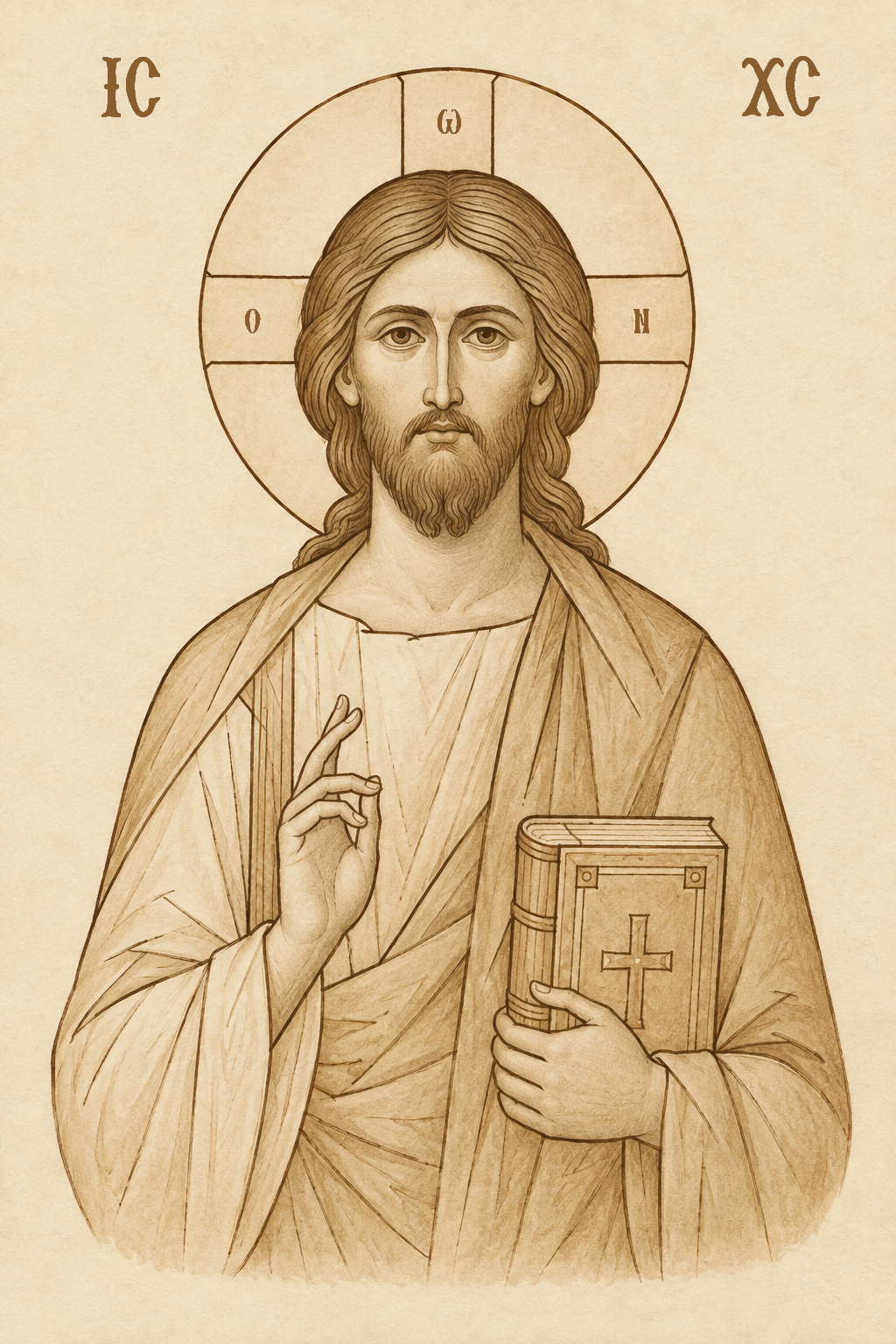
The incarnation makes Christian iconography possible: the invisible God becomes visible in the flesh of His Son.
An icon of Christ does not attempt to depict the invisible divine essence. It depicts the incarnate Person of the Son, who truly entered human history and became visible.
Veneration offered before an icon is not worship of wood or paint; worship belongs to God alone.
9. Scripture for study
Isaiah 7:14; 9:6–7; 53:1–12 — The promised Messiah, divine titles, suffering servant
Matthew 1:18–25; 3:13–17; 16:13–17; 28:18–20 — Christ’s birth, baptism, Peter’s confession, and authority
Luke 1:26–38; 2:1–20; 4:1–13; 22:39–46 — The annunciation, nativity, temptation, and Gethsemane
John 1:1–18; 5:19–29; 8:58; 10:22–39; 14:6–11; 20:24–31 — The eternal Word, divine identity, unity with the Father, and risen Lord
Romans 5:12–21 — Adam and Christ
1 Corinthians 15:1–28, 45–58 — Christ’s resurrection and the new humanity
Philippians 2:5–11 — Christ’s self-emptying, obedience, exaltation, and universal lordship
Colossians 1:15–20; 2:9–15 — Christ as image of the invisible God and the fullness of deity in bodily form
Hebrews 1:1–4; 2:9–18; 4:14–16 — The Son’s divinity, authentic humanity, suffering, and priesthood
1 John 1:1–4; 4:1–3, 9–15 — Confession of Christ come in the flesh
Questions for reflection
What does “begotten, not made” protect in the Church’s confession of Christ?
Why must Christ be both fully God and fully human if humanity is to be saved?
How does the title Theotokos defend the truth about Jesus Christ rather than primarily making a claim about Mary?
What would be lost if Christ only appeared to be human, or if He were a created being rather than true God?
What does it mean that Christ has both a divine will and a real human will?
How do the incarnation and resurrection shape a Christian view of the body and bodily life?
In what practical area of life do I most need to let the confession “Jesus Christ is Lord” become obedience rather than mere language?
How does union with Christ through the Church differ from simply trying to imitate Him by personal effort?